



FTLab Wireless Smart Geiger — Part 1
In 2017, I bought an FTLab Wireless Smart Geiger because I was curious about measuring the background radioactivity at my place and also because it was the cheapest device I found at that time. Measuring radioactivity seems to be an expensive “hobby”.
Radioactivity
Quick reminder about radioactivity: radioactive decay is an unstable atom losing energy through radiation. There are mainly three types of radioactivity:
- alpha: 2 protons + 2 neutrons (basically a helium nucleus), can be stopped by a sheet of paper, but they will never reach the sheet of paper, as 5 cm of air is enough to stop that type of radiation;
- beta: high-energy electrons (or positrons), can be stopped by a sheet of aluminum;
- gamma: high-energy photons (X-ray and higher), for 137Cs (662 keV), 2.2 cm of lead can reduce 90 % of its intensity.
But don’t let the alpha radiation weakness fool you. It’s still a health hazard when you ingest or inhale an alpha-radiation source, like radon gas that tends to accumulate in houses, especially in granitic regions.
The device
General information
- Brand: FTLab, a South Korean company
- Model: BSG-001
- Name: Wireless Smart Geiger
- Price: 65 €
- Availability: retired product
From an amazon listing:
- Measurement: Gamma, X-ray;
- Range: 0.05 to 200 µSv/h;
- Accuracy: ±15%;
- Size: 58×58×18.5 mm;
- Weight: 30 g.
Functions
- Gamma-ray detector.
- Bluetooth LE connectivity.
- Works with an iOS or Android app.
- Shows “live” data, refreshed every minute.
- Can record data in the device memory every 10 or 60 minutes for 10 days to a month (power loss will reset the counter).
Hardware
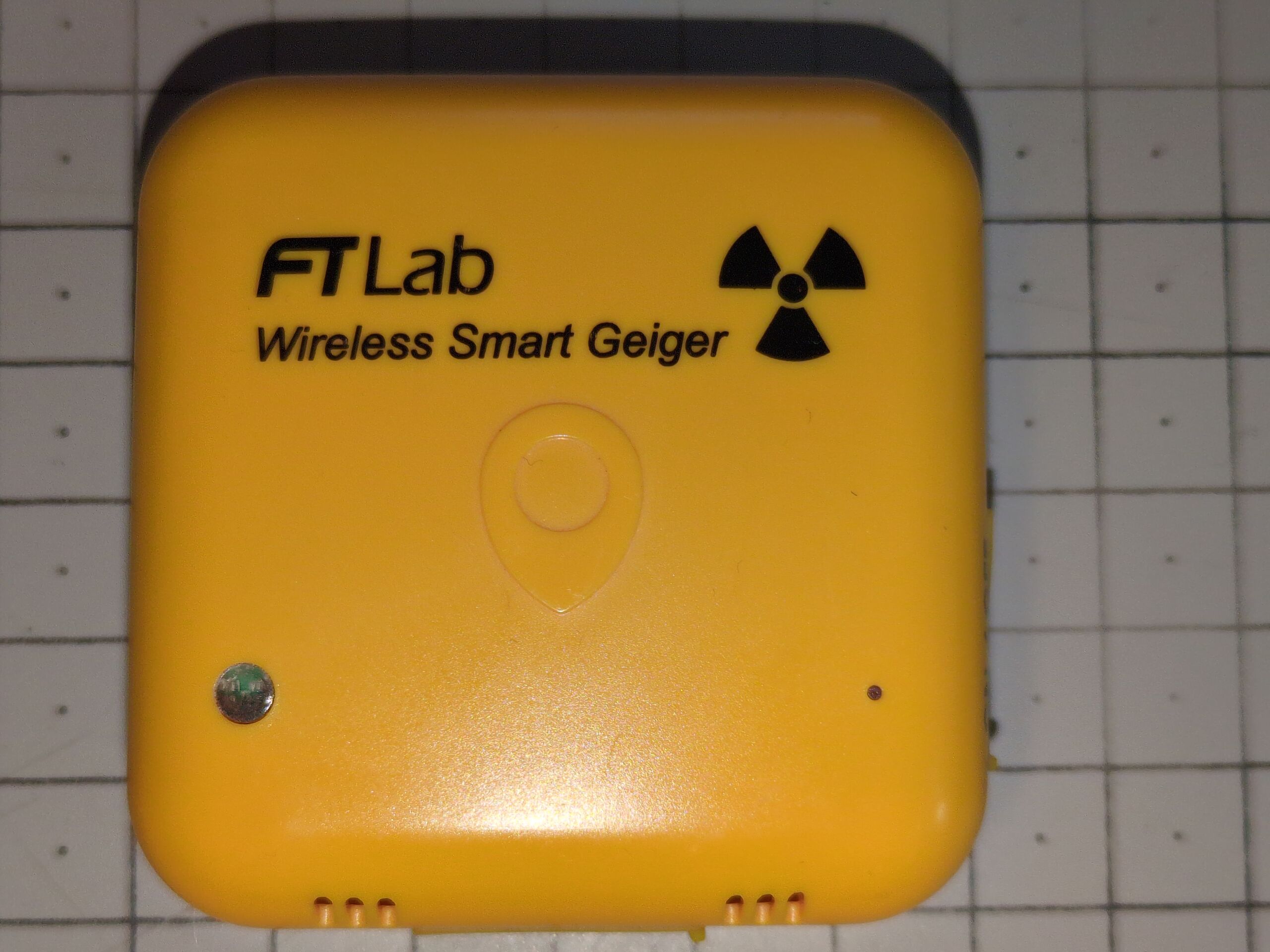
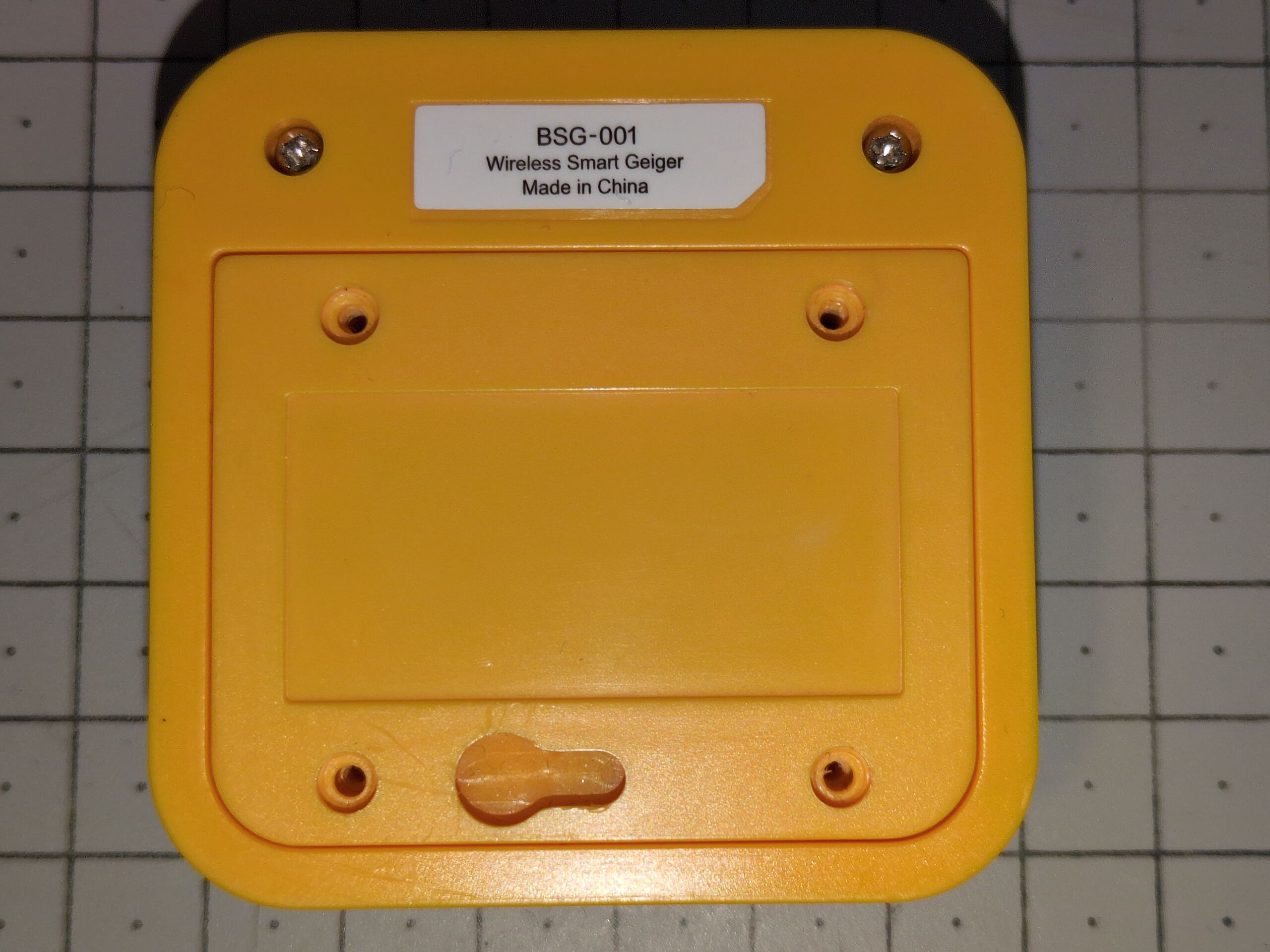
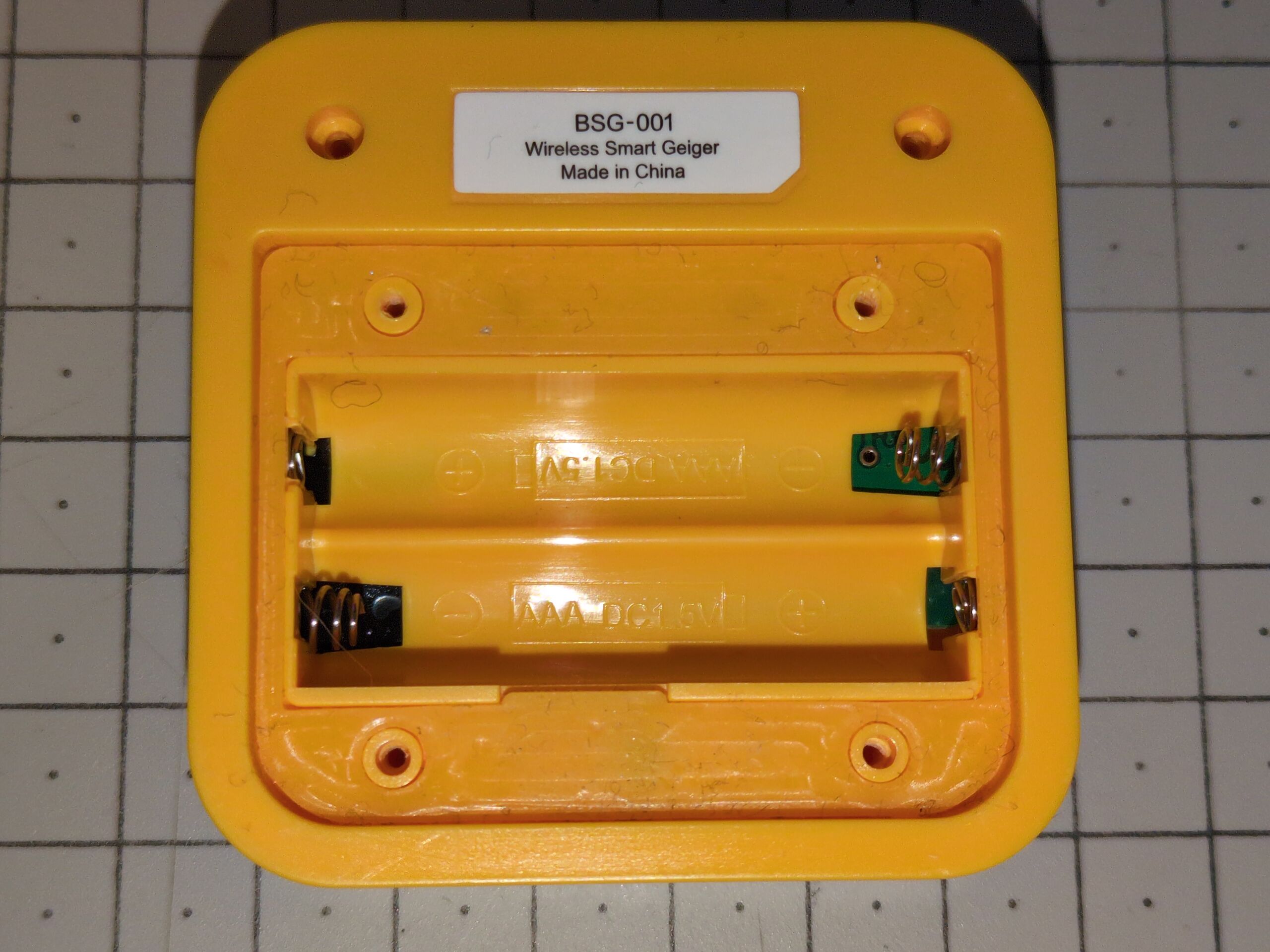
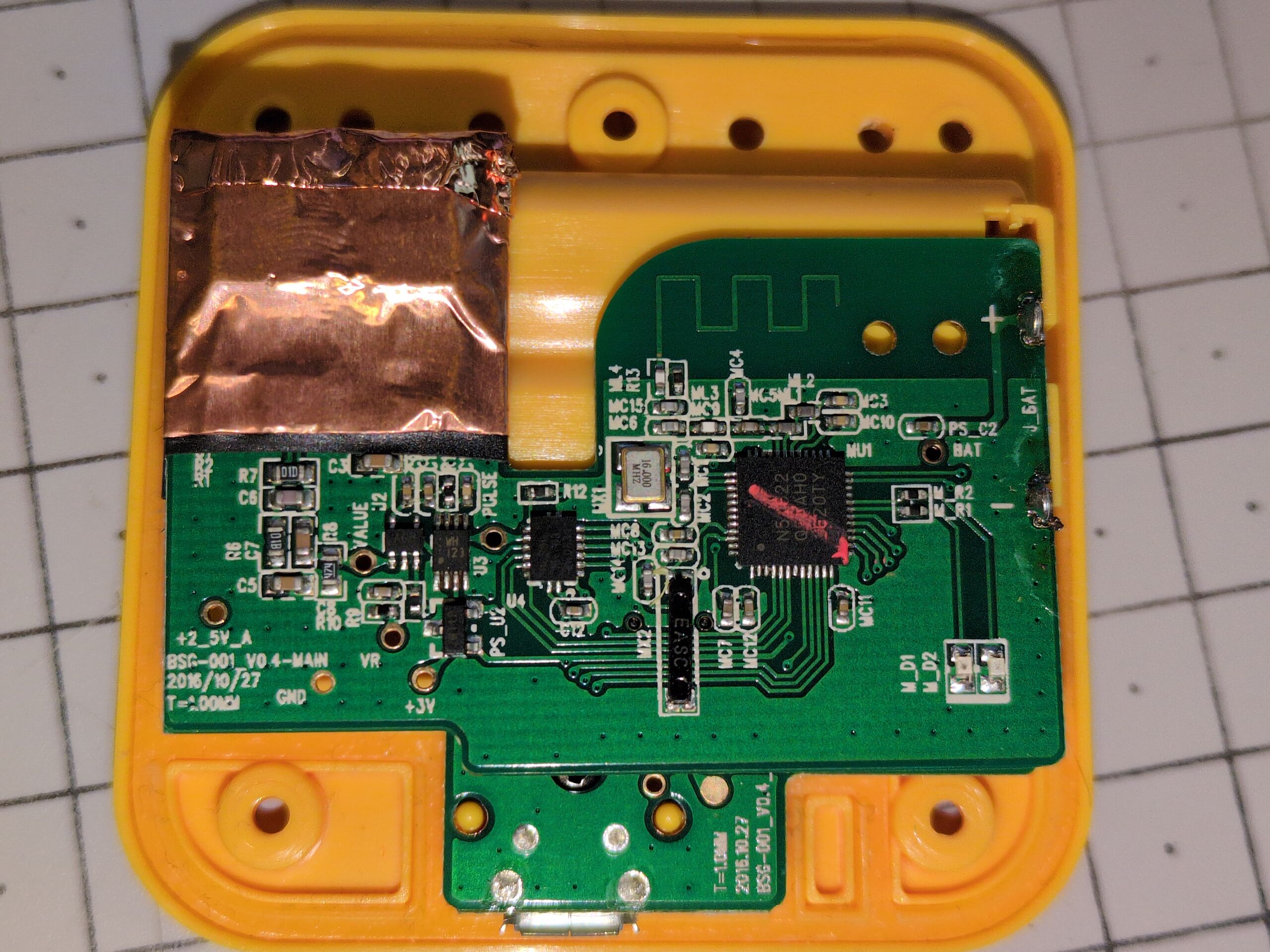
The main chip is a Nordic Semiconductor nRF51822 (QFAA H0 variant), a system on chip combining an ARM Cortex-M0 and a 2.4 GHz Bluetooth LE radio.
It’s powered either by two AAA batteries or by USB.
The gamma-ray sensor is under the copper sheet. From what I gathered by comparing my measurements against the datasheet of the GDK101, a sensor module made by FTLab around the same time (with ten PIN photodiodes), it’s probably composed of two PIN photodiodes. The sensor is sensitive to light (hence the copper sheet to protect it) and vibration (but the BSG-001 lacks a vibration sensor to cancel it out, unlike the GDK101).
More importantly, what is this sensor sensitive to?
The original packaging said the device is a gamma sensor; the Bluetooth name (BLE_Gamma) goes in the same direction; the copper sheet gives a hint that it can’t be a good alpha or beta sensor.
Assuming the same photodiodes were used in the BSG-001 and the GDK101, we know that the GDK101 is calibrated for 137Cs from its datasheet.
So that should detect nuclear fission products, but its readings of the natural background radiation may be off (which is at higher energies).
There’s an LED blinking in green from time to time, or faster during Bluetooth communication. That LED blinks red when the readings are high (but I don’t know what the threshold is).
Software
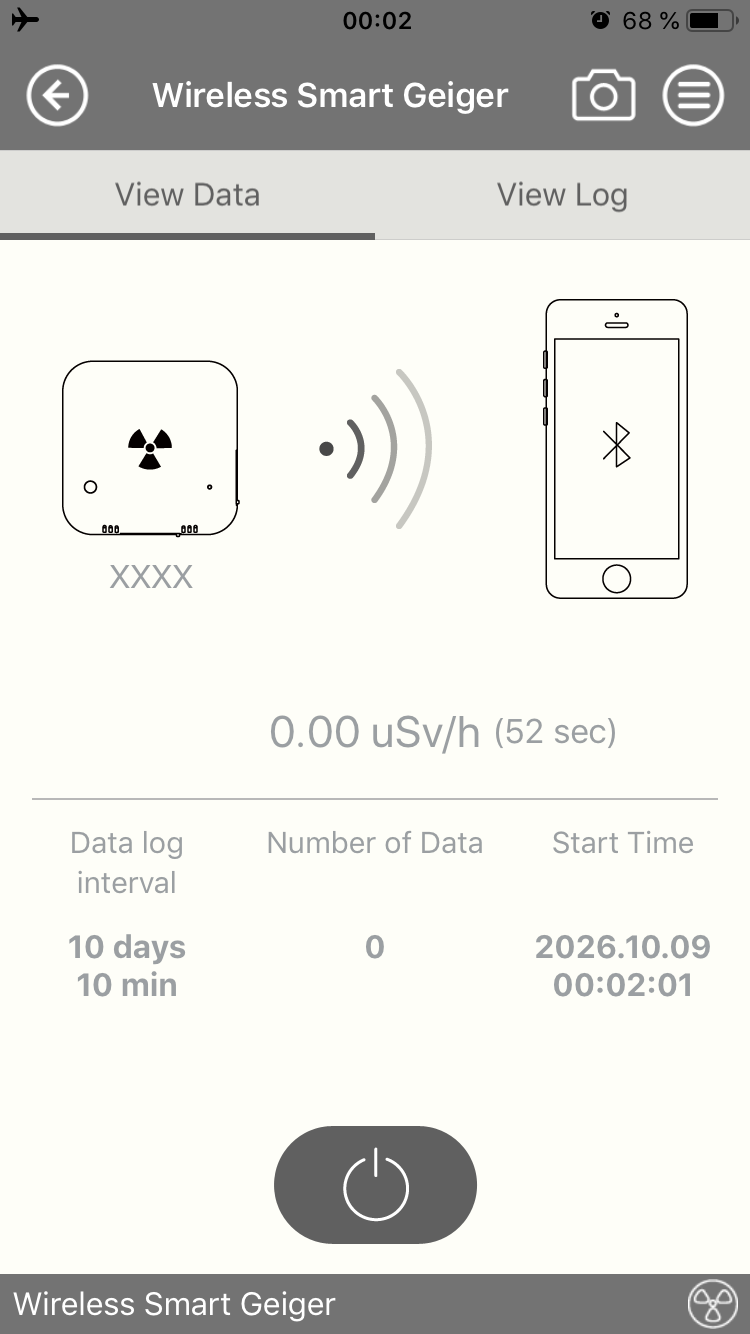
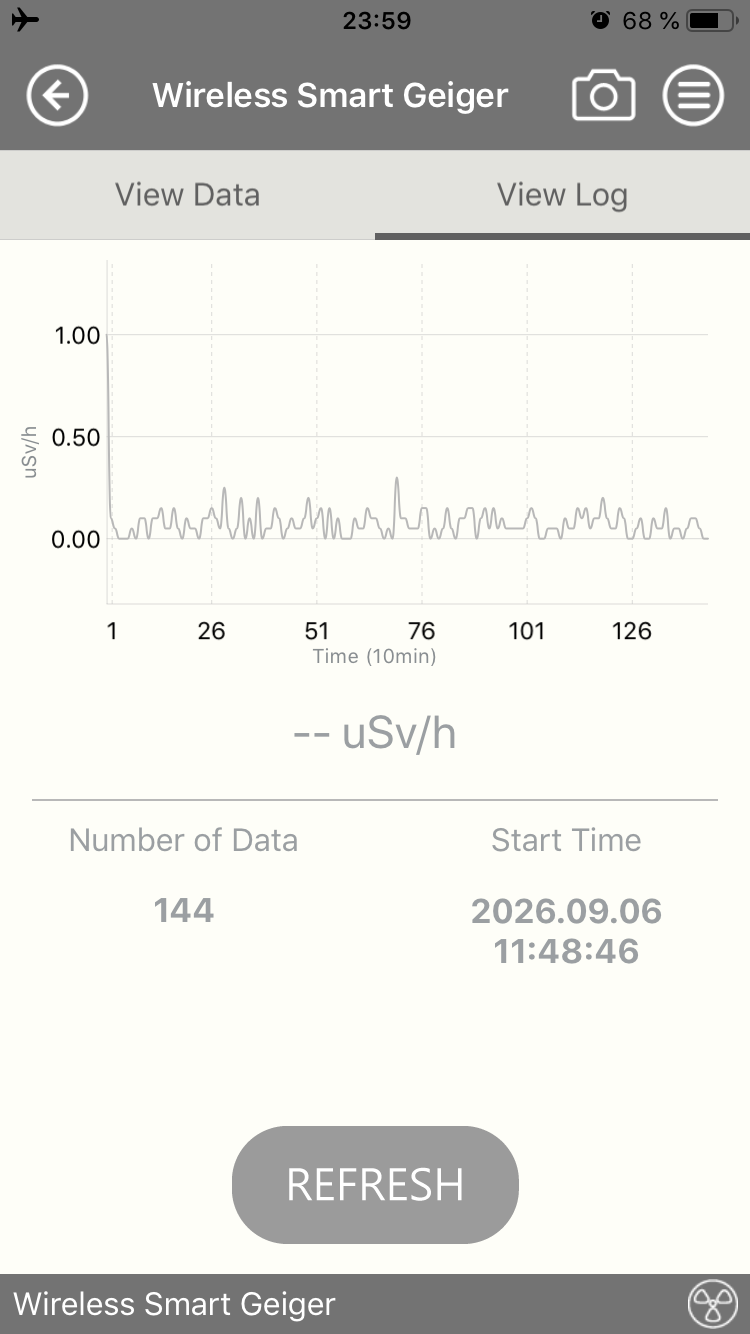
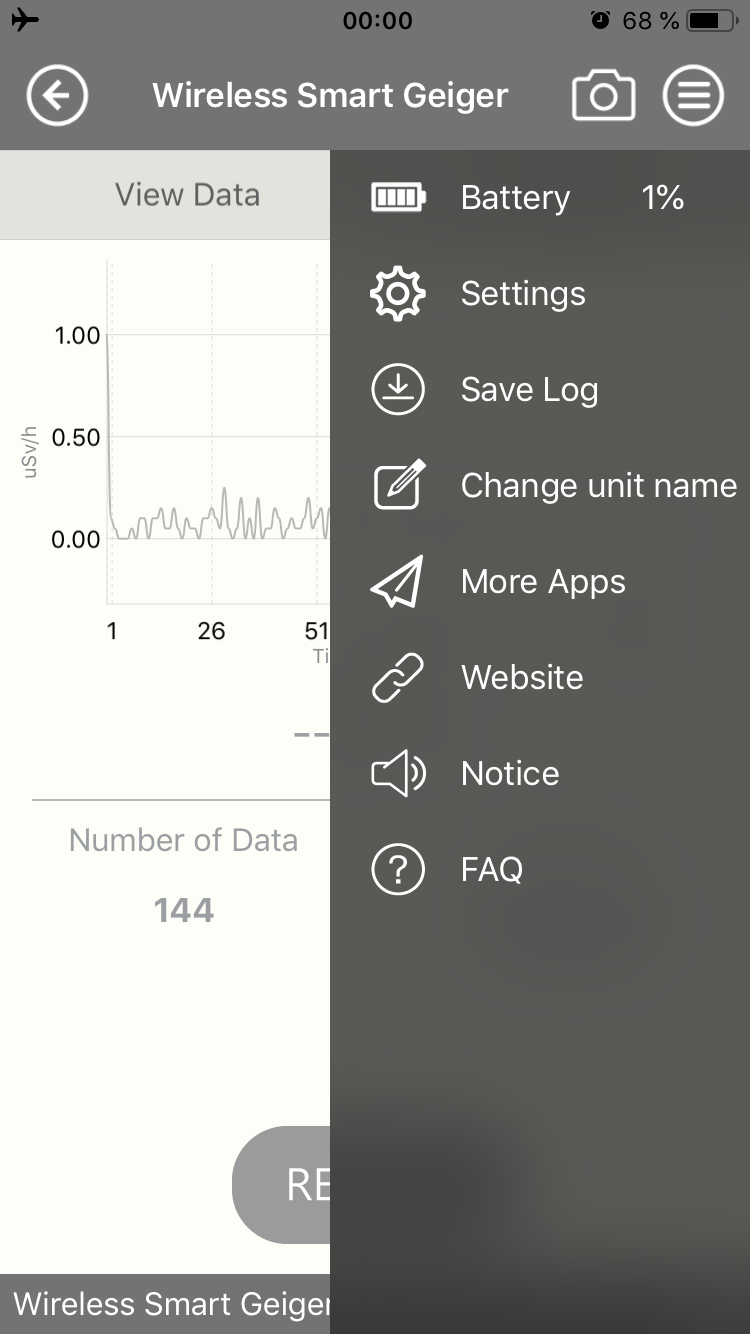
A few things to notice:
- the measured battery level is wrong (I think the issue was in the iOS app, as the Android app showed a more realistic value);
- measurements are in µSv/h (except they didn’t bother to use “µ” and used “u” instead), which is an interesting unit, given it’s a probabilistic unit (of health risk).
The sensor has a range of 0.05 to 200 µSv/h. For reference:
- global average background radiation: 0.27 µSv/h:
- from terrestrial radiation: 0.053 µSv/h;
- from cosmic radiation: 0.045 µSv/h;
- from radon radiation: 0.148 µSv/h;
- from other internal radiation: 0.026 µSv/h;
- Finland average background radiation: 0.9 µSv/h;
- background radiation in a commercial airplane: 2.7 µSv/h;
- the most radioactive house in Rāmsar, Iran: 15 µSv/h;
- radiation from the first atomic bomb fallout (32 km away): 190 000 µSv/h.
This sensor, at best, should get the terrestrial and cosmic radiation, so about 0.1 µSv/h. And if it nears its maximum: run 😉.
Issues
I have a few issues with this device:
- there is no official documentation available anymore as far as I can tell;
- the app does not exist anymore: not on the App Store, not on Google Play (you can find some old APKs for Android 10 on some mirrors);
- the app was quite bad anyway;
- no alert/notification/buzzer when readings go over a certain threshold;
- I want to connect it to my computer or my home automation system.
Conclusion so far
So what we know here is that we have a not very precise gamma detector that can tell you if there was a nuclear accident or a nuclear explosion nearby… I guess that’s something you may be able to be aware of even without this device.
Frankly, I think a radon detector is way more valuable in everyday life. Which may also be why FTLab now specializes in radon detection.
If you are still interested in gamma radiation and live in France, you can use the free TELERAY service.
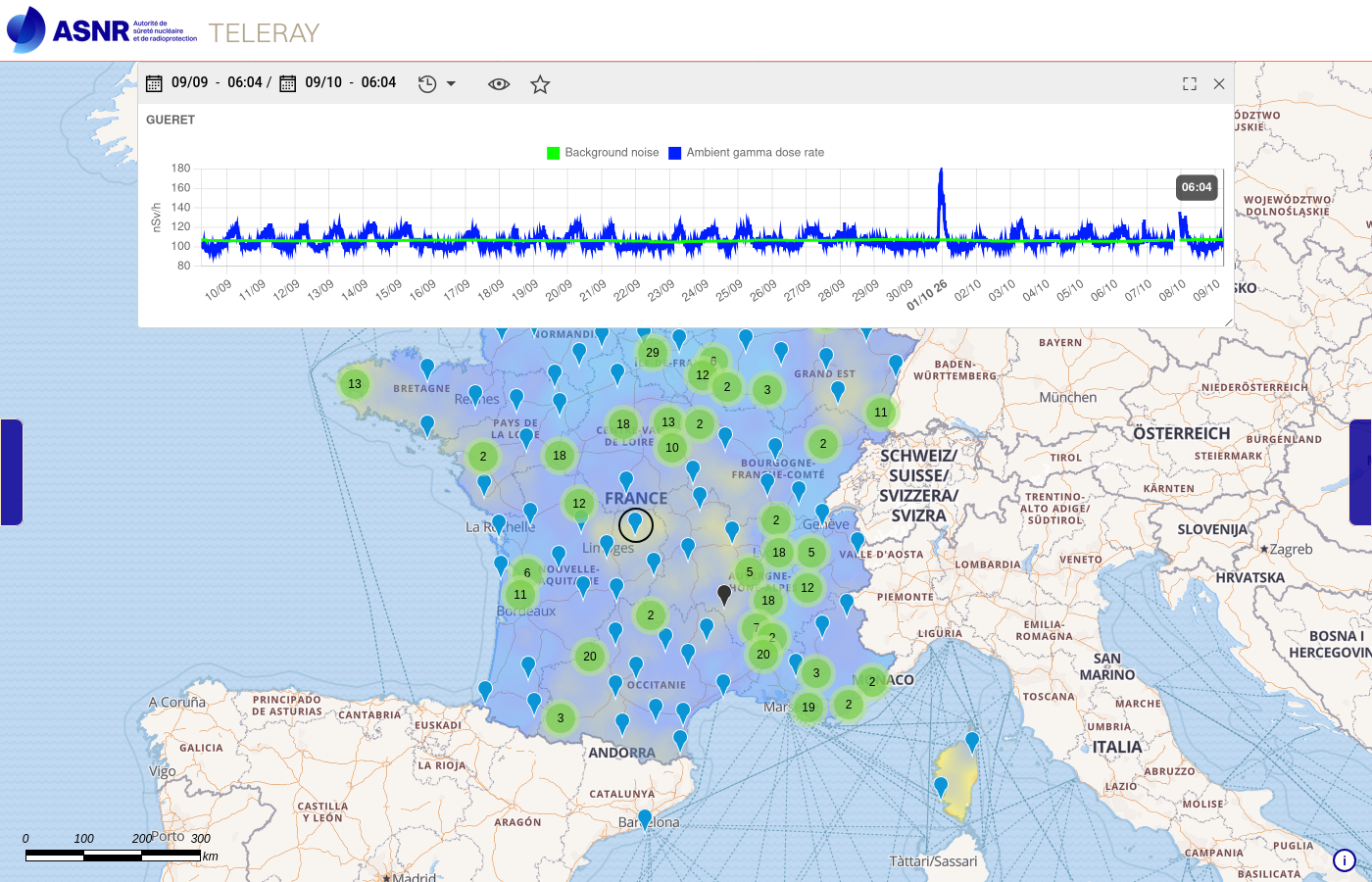
So let’s dig into this device in the next post(s) and see what we can do with it to make it more useful.


 Comments
Add one by emailing me.